

The Federal High Court sitting in Lagos has dismissed a suit seeking to declare the Nigerian Christian Pilgrims Commission (NCPC) and the National Hajj Commission (NAHCON) Acts as unconstitutional.
This decision affirms the legality of government-established religious commissions in the country.
Justice Akintayo Aluko held that the Applicant, Human Rights and Empowerment Project Ltd/Gte, failed to provide credible evidence that the statutes violated Sections 10 and 42 of the Constitution of the Federal Republic of Nigeria, 1999 (as amended).
On October 17, 2024, the Applicant had approached the court, seeking a series of declarations and orders.
These included a declaration that the NCPC and NAHCON Acts were inconsistent with the Constitution, and an order restraining the Federal Government from funding or subsidising religious pilgrimages for Christians and Muslims.
The suit argued that such sponsorship was discriminatory against adherents of other faiths and amounted to an unconstitutional adoption of state religion.
In its affidavit, the Applicant relied largely on newspaper reports and argued that government allocations for pilgrimages amounted to misuse of taxpayers’ funds.
The Applicant also sought to highlight alleged breaches of the fundamental right to freedom from discrimination under Section 42 of the Constitution.
During the hearing on October 9, 2025, counsel for the Applicant urged the court to hold that government sponsorship of pilgrimages breached constitutional provisions, noting that restricting funding to only Christian and Muslim pilgrims was discriminatory.
However, the 4th Respondent, NAHCON, countered that all Hajj payments were made directly by intending pilgrims through state-level Muslim Pilgrims Welfare Boards, not from public funds.
Counsel for NAHCON further submitted that the existence of the religious commissions did not amount to adopting a state religion, and that the Applicant had not shown any identifiable group of citizens whose rights were violated.
In resolving the first issue, Justice Aluko examined the provisions of Sections 10 and 42 of the Constitution. Section 10 prohibits any government from adopting a religion as a state religion, while Section 42 protects citizens from discrimination based on religion, ethnicity, or other grounds.
The court held that there was no credible evidence that either Act led to the adoption of a state religion or violated the right to freedom from discrimination.
On the second issue regarding the alleged misuse of taxpayers’ funds, the court noted that the Applicant’s own evidence indicated that the Lagos State Government had saved N4.5 billion over three years by ceasing the sponsorship of pilgrimages, redirecting the funds to infrastructure projects.
Justice Aluko emphasised that the Applicant’s reliance on newspaper publications was inadequate, describing such evidence as hearsay unless properly certified under the law.
The judgment also highlighted that declaratory reliefs require strong and convincing proof, which the Applicant failed to provide.
The court stressed that allegations without concrete evidence, particularly those relying on speculation or media reports, could not sustain a constitutional claim.
Consequently, the court dismissed the suit, finding that the Applicant’s case lacked merit and substance.
-Advertisement-
Grab our latest Magazine, "Kelechi Amadi-Obi - Transcending the worlds of Law, Visual Art and Photography". Get your order fast and stress free.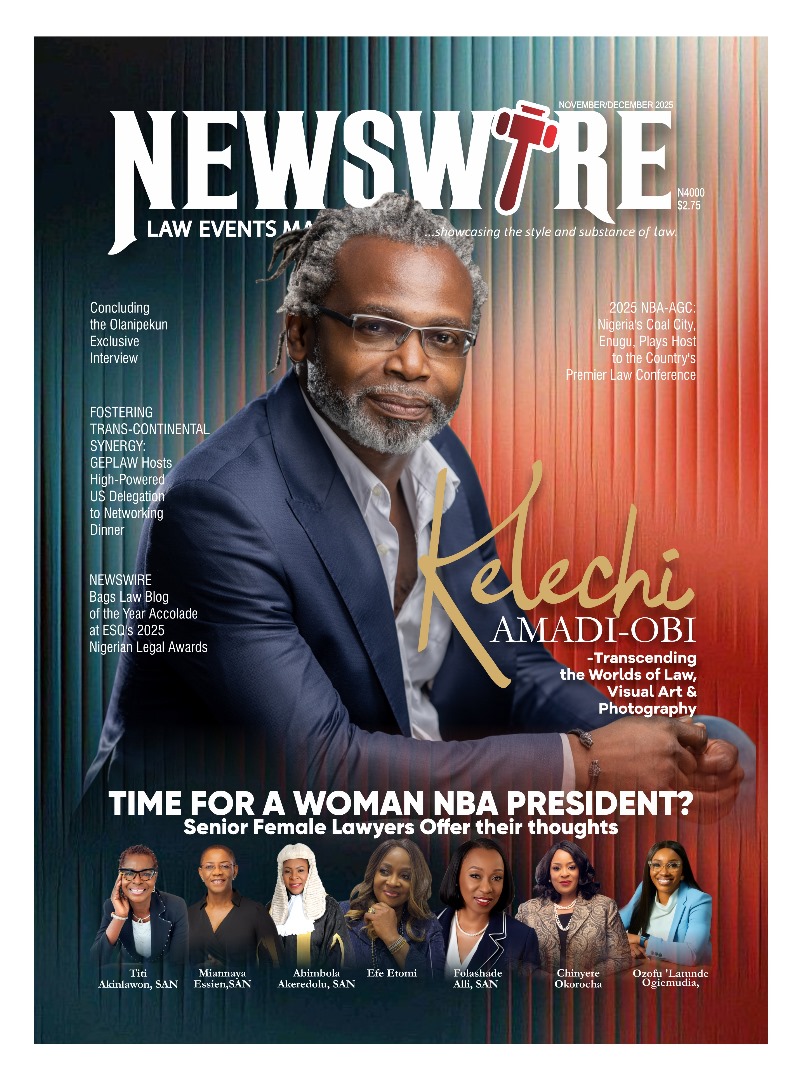
For more details about Newswire Law&Events Magazine, kindly reach out to us on 08039218044, 09070309355. Email: newswiremagazine@yahoo.co.uk. You will be glad you did
Download E-MagazineDo you want to be heard, your events covered, your articles published, or need to advertise your products and services on our Blog and Magazine, reach out to us at Newswire Law and Events, you will be glad you did. For more details about our services, please call: 08039218044, 09070309355. Email: newswiremagazine@yahoo.co.uk