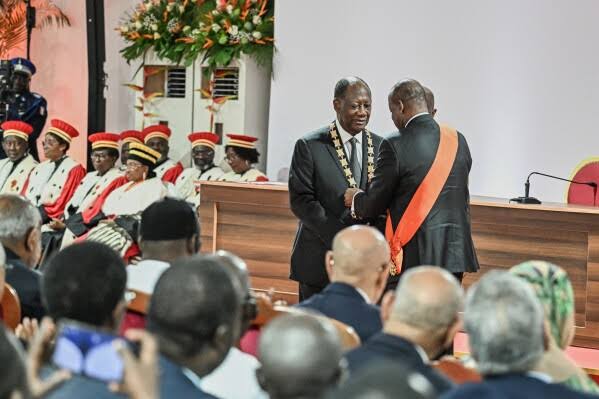

President Alassane Ouattara was on Monday sworn in for a fourth term as leader of the Ivory Coast, after elections in which his two main opponents were excluded from the ballot.
The 83-year-old was reelected with nearly 90 percent of the vote in the October 25 election — though turnout in the West African nation was a relatively low 50.1 percent.
The president, who has led the Ivory Coast since a violently disputed election in 2010, vowed to “loyally defend the constitution” at his inauguration.
And the veteran politician — who will turn 84 in January — promised that his fourth term would be one of “generational transition”.
Leaders from 11 African countries attended the ceremony at the presidential palace in the economic capital Abidjan, as well as former leaders such as Niger’s Mahamadou Issoufou.
Former colonial ruler France, which maintains good relations with the Ivory Coast, was represented by National Assembly Speaker Yael Braun-Pivet.
The United States sent Jacob Helberg, Under Secretary of State for Economic Affairs, who was due to meet with Ouattara in the afternoon.
Ouattara’s two main opponents, Laurent Gbagbo and Tidjane Thiam, were excluded from the ballot — Gbagbo due to a criminal conviction and Thiam over nationality issues.
Neither politician attended the ceremony.
Profoundly Changed
Ouattara first came to power following a presidential clash between him and Laurent Gbagbo in 2010 and 2011, which cost more than 3,000 lives among their supporters.
In his speech after the oath-taking ceremony, Ouattara remarked that the Ivory Coast had “profoundly changed” since he first took power.
“We have restored the authority of the state, consolidated peace, strengthened national cohesion, and our institutions. We have ensured security throughout the national territory,” he insisted.
Throughout his time in power, Ouattara has been among the foremost critics of the coups to have plagued the region, most recently in Guinea-Bissau, as well as an attempted coup in Benin at the weekend.
That stance has earned him the enmity of several fellow West African leaders, not least the Sahel juntas in neighbouring Burkina Faso, Mali, and Niger.
Ouattara, however, insisted that his foreign policy remained guided by the following principle: “Ivory Coast, friend to all and enemy to no one.”
On the question of his potential successor — a subject of constant speculation since the death of his previously anointed replacement, Amadou Gon Coulibaly — Ouattara insists that some handover of power to those younger than him would take place.
“This term will be one of generational transmission; it will be, for our nation and me, an act of responsibility and political maturity,” he said.
-Advertisement-
Grab our latest Magazine, "Kelechi Amadi-Obi - Transcending the worlds of Law, Visual Art and Photography". Get your order fast and stress free.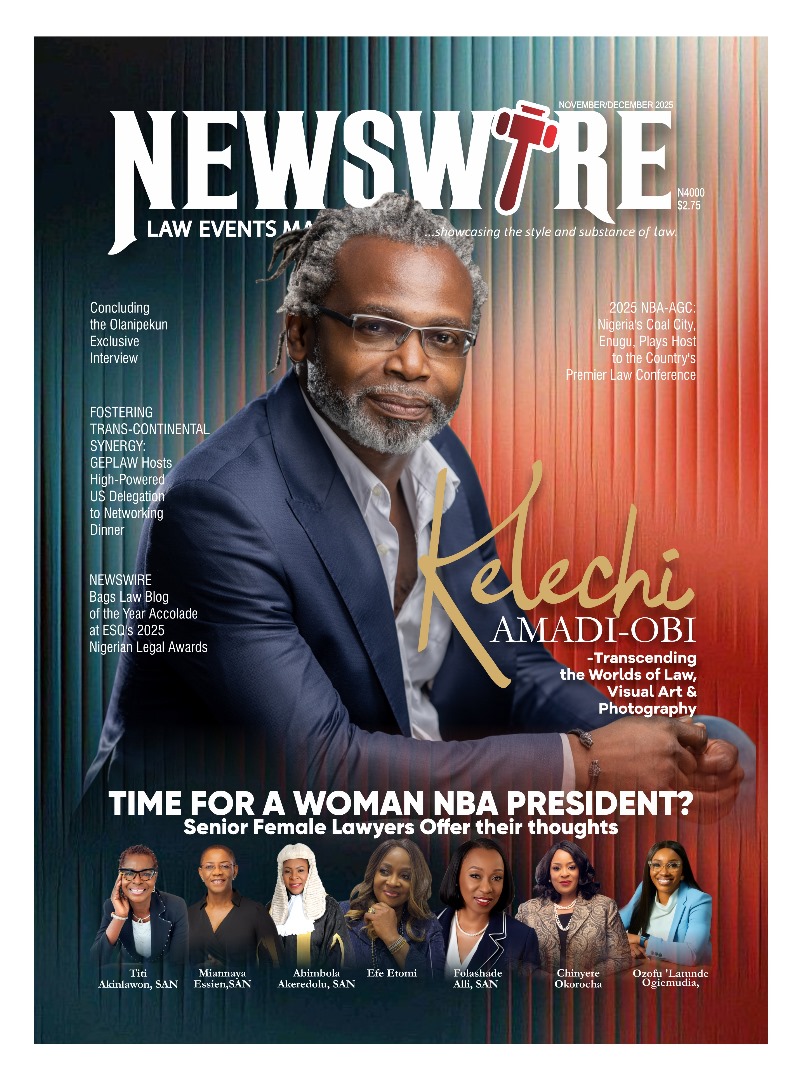
For more details about Newswire Law&Events Magazine, kindly reach out to us on 08039218044, 09070309355. Email: newswiremagazine@yahoo.co.uk. You will be glad you did
Download E-MagazineDo you want to be heard, your events covered, your articles published, or need to advertise your products and services on our Blog and Magazine, reach out to us at Newswire Law and Events, you will be glad you did. For more details about our services, please call: 08039218044, 09070309355. Email: newswiremagazine@yahoo.co.uk