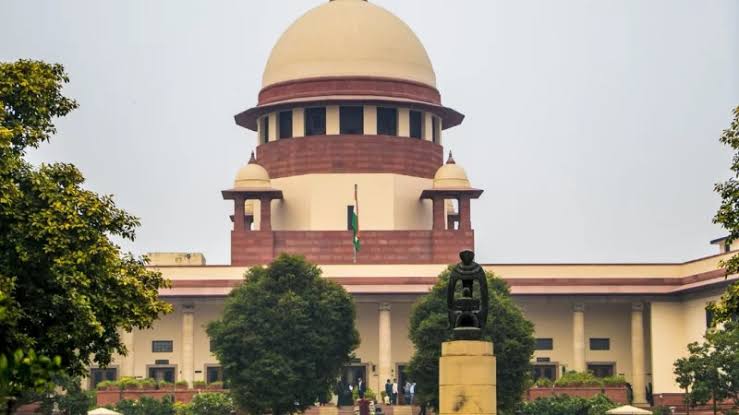

India’s Supreme Court prides itself on defending the rights of Dalits – historically the country’s most oppressed citizens.
But a new study argues that the court’s own language has frequently reflected the caste hierarchies it aims to erase. About 160 million Indians are Dalits, once called “untouchables”, yet many remain trapped in menial jobs and shut out of social and economic opportunity.
For much of independent India’s history, the country’s top judges have struggled to speak about Dalits in ways that recognise dignity rather than reinforce stigma, the study found. That tension – between progressive legal outcomes and regressive language – is the central paradox documented in a sweeping review of 75 years of judgments of the top court.
The University of Melbourne-funded research, conducted in partnership with the Supreme Court, offers a rare internal reckoning for one of the world’s most powerful judiciaries.
The study examines “constitution bench” rulings – decided by five or more judges – from 1950 to 2025. These rulings are especially important because they set legal precedents, are taught in law schools, invoked in courtrooms and cited by later benches.
It found that while these landmark decisions often upheld Dalit rights, their language could be “demeaning or insensitive”, notes Professor Farrah Ahmed of Melbourne Law School, a co-author of the study.
Some judgments liken caste oppression to disability, implying that the oppressed or disabled are inherently inferior.
Others assume – contrary to evidence – that education alone can erase caste, shifting the burden from society to individual Dalits who must study their way to equality. Still others overlook the caste barriers that block access to jobs, credit and markets, deepening poverty.
Some judges likened Dalits to “ordinary horses” in contrast to upper classes who were like “first class race horses”. Others described affirmative-action measures as “crutches” that Dalits should not depend on for too long.
Some judges even described the origins of caste as “benign” – merely a system of division of labour. This, researchers say, “supported a bitterly unfair status quo that confines oppressed castes to reviled and poorly paid work”.
A 2020 judgement cited by the study talked about “primitive way of life [of Scheduled Tribes or other marginalised tribespeople] makes them unfit to put up with the mainstream and to be governed by the ordinary laws” – and describes them as needing a “helping hand to uplift them and to make them contribute to the national development and not to remain part of the primitive culture”.
Such language, the study suggests, went beyond poor phrasing to reinforce harmful stereotypes.
“These comparisons – whether to animals or to people with disabilities – were offensive to both groups,” says Prof Ahmed. “The real problem is not any supposed inherent limitation, but the society around them, which fails to support them to thrive.”
-Advertisement-
Grab our latest Magazine, "Kelechi Amadi-Obi - Transcending the worlds of Law, Visual Art and Photography". Get your order fast and stress free.
For more details about Newswire Law&Events Magazine, kindly reach out to us on 08039218044, 09070309355. Email: newswiremagazine@yahoo.co.uk. You will be glad you did
Download E-MagazineDo you want to be heard, your events covered, your articles published, or need to advertise your products and services on our Blog and Magazine, reach out to us at Newswire Law and Events, you will be glad you did. For more details about our services, please call: 08039218044, 09070309355. Email: newswiremagazine@yahoo.co.uk