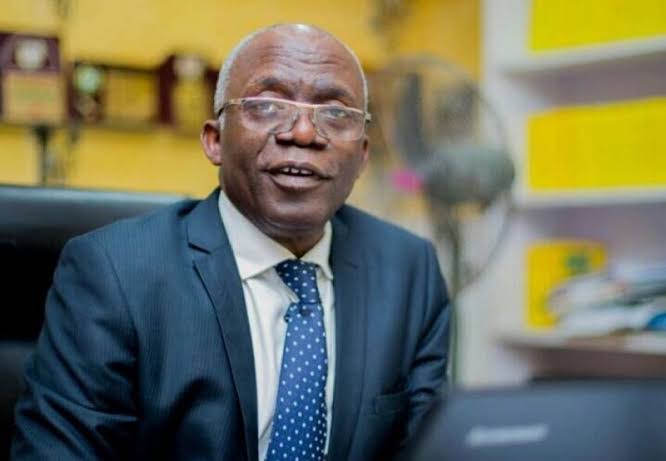

Human rights lawyer and activist, Femi Falana (SAN), has said that liberal bail conditions for treasonable offences were feasible under military rule while onerous bail conditions have become the practice under democratic system of government.
Falana said that bail conditions set by judges under military rule were not as stringent as bail conditions imposed on citizens charged with criminal offences under the current democratic dispensation
He said that Section 35 of the 1999 Constitution of the Federal Republic of Nigeria and Article 6 of the African Charter on Human and Peoples’ Rights (Ratification and Enforcement) Act, Cap A9, Laws of the Federation of Nigeria 2004, uphold the personal liberty of every individual.
According to him, although the state may limit this right if there is reasonable suspicion that someone has committed a criminal offence, a suspect is entitled to bail while awaiting trial, investigation, or appeal.
“However, bail may be denied if evidence shows that an accused person could interfere with an investigation, flee, or continue committing the crime.
“The principle behind granting bail before trial is to prevent wrongful detention, as every person is presumed innocent until proven guilty in court,” he said.
He noted that in Obekpa v. Commissioner of Police (1980), Al-Hassan Idoko J. (as he then was) emphasised, “The spirit behind Section 32(4) (a) and (b) of the Constitution is to avoid wrongful incarceration of an accused person until proven guilty.
“This privilege allows individuals wrongly accused to avoid unjust punishment, ensuring access to legal counsel, preparation for defense, and the preservation of the presumption of innocence.”
Falana recalled that in Nigeria’s Second Republic, judges granted bail liberally in line with Section 32 of the 1979 Constitution, which aligns with Section 35 of the 1999 Constitution.
He noted, “Even under the military regime, politicians and activists charged with treason or treasonable felony were often granted bail under relatively lenient conditions.
“Commissioner of Police v. Dr. Beko Ransome Kuti & 4 Ors. (1992) Dr. Kuti and others were accused of treasonable felony for circulating posters calling for the removal of President Babangida.
“Chief Gani Fawehinmi and I, despite being held incommunicado in Kuje Prison, argued for our bail.
“The Chief Magistrate initially did not have access to the authorities we cited but allowed us to submit them via our lawyers.
“Two weeks later, we were granted bail in the sum of N20,000 each, with one surety in the same amount.
“M.K.O. Abiola v. Federal Republic of Nigeria (1995) After declaring himself President due to winning the 1993 election, M.K.O. Abiola was charged with treason.”
Falana said his application for bail was initially denied, but the Court of Appeal reversed the decision, granting bail on his self-recognizance, with the condition that he refrain from activities jeopardising national peace.
He said that in the case of Ahmed Ebute & 5 Ors v. The State (1994), several senators were accused of plotting to remove General Sani Abacha.
“Despite the charges, the Court of Appeal granted bail in the form of self-recognition, with conditions on the submission of passports and regular attendance at the police station,” he said.
According to him, “Under Nigeria’s current democratic system, judges have increasingly imposed stringent bail conditions, even when the prosecution’s evidence appears weak.”
“For example, some Federal High Court judges demand bail sums as high as 100 million Naira, with sureties who own property in high-end areas like Ikoyi or Victoria Island, or are high-ranking public servants.
“It is striking that during the military era, judges imposed far less restrictive bail conditions for individuals charged with treason.”
He said that in the case of FRN v Omoyele Sowore & Anor (2019), Omoyele Sowore and Olawale Bakare were charged with treasonable felony.
Despite being granted bail, the conditions included N100 million for Sowore and N50 million for Bakare, both with stringent property and residency requirements.
The defendants were also restricted from attending rallies and had limited movement.
When they couldn’t meet these conditions, they remained in detention until the conditions were later varied by the Court of Appeal.
Also, in the case of FRN v Michael Tobiloba Adaramoye (2024), the defendants involved in the #EndBadGovernance protests faced bail conditions of N10 million each, with one surety possessing property worth the bail sum. Their passports were also required.
In the case of FRN v Adebayo & 118 Ors (2024), involving defendants accused of participating in the #EndBadGovernance protests, they were granted bail with similar conditions, including N10 million for each defendant and sureties who must be senior civil servants.
“The children involved were granted bail to their parents, who were required to stand as sureties.
“It is contradictory to grant bail and then impose conditions that the defendants are unable to meet, forcing them to seek a variation or appeal,” he said.
He questioned, “How could poor parents from far-off states like Kano or Sokoto be expected to travel to Abuja to stand as sureties for their children?”
According to him, “In a country where the national minimum wage is just N70,000, how many people can afford to meet bail conditions like N100 million?”
He recalled that in a 2025 case involving Sowore, the Nigeria Police Force initially imposed stringent bail conditions, requiring a Grade 17 civil servant as a surety.
After my intervention, the authorities amended the condition to a Grade 16 officer, illustrating the difficulty many suspects face in meeting such requirements.
He said, “In many cases, even when bail conditions are met, there are delays in verifying the documents, leading to prolonged detention.
“High-profile individuals are often able to meet these conditions quickly, but ordinary citizens struggle to fulfill them.
“The Court of Appeal has even ruled that involving top-level civil servants as sureties in bail cases is illegal, as it contradicts the Civil and Public Service Rules.
“Given the clarity of the law on bail, Nigerian judges should eliminate unnecessary adjournments for bail applications, as these are often eventually granted.
“Judges should move forward with setting bail conditions promptly after charges are filed. Additionally, given that many Nigerians live in poverty, ownership of property should not be a mandatory requirement for bail.
“Otherwise, overcrowding in correctional centers will continue due to the inability of poor defendants to meet stringent bail conditions.”
-Advertisement-
Grab our latest Magazine, "Chief Wole Olanipekun, CFR, SAN, A man of wide horizons and deep intentions". Get your order fast and stress free.
For more details about Newswire Law&Events Magazine, kindly reach out to us on 08039218044, 09070309355. Email: newswiremagazine@yahoo.co.uk. You will be glad you did
Download E-MagazineDo you want to be heard, your events covered, your articles published, or need to advertise your products and services on our Blog and Magazine, reach out to us at Newswire Law and Events, you will be glad you did. For more details about our services, please call: 08039218044, 09070309355. Email: newswiremagazine@yahoo.co.uk